
Coding Is Not About Syntax. It’s About How You Think.
When people ask me what coding is, they expect a technical answer. They expect me to talk about programming languages, frameworks, or algorithms. And yes, those things are part of it. But after years of writing code as a Java Full Stack and Automation developer, working with automation platforms like Camunda, Appian, and Pega, debugging systems, and learning from mistakes, I have come to see coding differently.
Coding is not just about giving instructions to a computer. It is a way of thinking. It is a way of breaking down problems, expressing ideas clearly, and making decisions that will matter months or years later. The computer is just the listener. The real work happens inside your head.
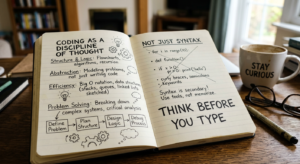
I want to share what I have learned about coding as a practice, not just as a skill. This is not a tutorial. It is a reflection from someone who has been writing Java code for full stack applications and building automation solutions using Camunda, Appian, and Pega for long enough to know that the keyboard is the easy part. My journey has been shaped by these experiences, but the lessons I share apply to any kind of coding.
The Most Important Work Happens Before You Type
Early in my career as a Java developer, I thought being productive meant writing code quickly. I would jump into implementation as soon as I got a problem. I wanted to see results. I wanted to feel progress. Whether I was building a backend API with Spring Boot, creating a frontend with Angular, designing a workflow in Camunda, or configuring a rule in Appian or Pega, my instinct was the same. Start building immediately.
Over time, I learned that this approach often backfired. I would write code, realize it did not fit the requirements, and rewrite it. Or I would discover halfway through that I had misunderstood the problem entirely. I cannot tell you how many times I built a complex workflow in Camunda only to realize that the process itself was flawed, not the implementation. The same happened with Appian and Pega. The tool was never the problem. My understanding was.
Now I do something different. Before I write a single line of Java, before I drag a node in Camunda, before I configure an interface in Appian or a case type in Pega, I spend time thinking:
-
What is the real problem?
-
What are the constraints?
-
What are the assumptions I am making?
-
What could go wrong?
-
How will this process behave when data is missing or when a user takes an unexpected path?
This thinking time feels slow. But it saves enormous effort later. A well understood problem often leads to simple, clean solutions. A poorly understood problem leads to confusion, rework, and frustration. Coding and automation start in the mind, not on the screen. I learned this the hard way through many late nights of fixing workflows that should have been right the first time.
Syntax Is Easy. Thinking Is Hard.
Anyone can learn Java syntax. You can memorize keywords, understand data types, and learn how to write loops and conditionals. The same applies to automation platforms. You can learn how to create a process model in Camunda, how to build an interface in Appian, or how to configure a case lifecycle in Pega. With enough practice, you can make things work. That is not the hard part.
The hard part is designing solutions that are clear, maintainable, and correct. That requires thinking. It requires:
-
Deciding how to name your process variables so that another developer can understand them instantly
-
Choosing the right level of abstraction
-
Anticipating how the workflow might need to change when business rules are updated
I have seen developers who know every feature of Camunda but design workflows that are impossible to debug. I have seen Appian applications that work perfectly on day one but become unmaintainable after six months. I have seen Pega rules that are so tightly coupled that changing one breaks ten others.
| Knowledge | Result |
|---|---|
| Knows every feature of Camunda | Designs impossible-to-debug workflows |
| Knows every Appian function | Builds unmaintainable applications |
| Knows every Pega rule type | Creates tightly coupled, fragile rules |
The difference is not knowledge of the tool. The difference is how they think.
The same applies to coding in Java. I have seen developers who know every corner of the language but write code that is confusing and fragile. I have also seen developers who know only a small part of the language but write code that is a pleasure to read and easy to change.
Syntax and tool knowledge are entry costs. Thinking is where the real value lives.
Coding Does Not Allow Vague Thinking
One thing I love about coding is that it is honest. You cannot fool a computer. You cannot say “it probably works” and hope for the best. The computer executes exactly what you write, not what you meant. The same honesty applies to automation platforms like Camunda, Appian, and Pega. If your process logic is vague, the workflow will behave in ways you did not expect.
This forces precision. If your thinking is vague, your code or workflow will break. Edge cases you did not consider will surface. Conditions you left ambiguous will cause errors. The platform has no mercy for unclear thinking. As a full stack developer, I see this on both ends:
-
A vague assumption on the backend → null pointer exception
-
A vague assumption in a Camunda workflow → process stuck forever
Over the years, this has trained me to be more precise in everything I do. I have become better at noticing gaps in my own reasoning. I have become more careful about assumptions. Coding and automation taught me that clarity is not optional. It is essential.
In my work with Appian and Pega, this precision is even more visible because business users often depend on these workflows:
-
A vague condition in a Pega rule → approves a request that should have been rejected
-
A poorly defined gateway in Camunda → routes a case to the wrong team
There is no room for “close enough.”
Abstractions Are Powerful but Dangerous
Modern coding relies heavily on abstraction. Libraries, frameworks, and tools allow us to build complex systems without managing every tiny detail. As a Java developer, I work with many abstractions every day:
-
Spring Boot hides complexity around dependency injection
-
Hibernate simplifies database access
-
Camunda, Appian, and Pega are powerful abstractions over workflow engines
These tools are powerful and they make us productive. Camunda allows you to model complex business processes visually. Appian lets you build enterprise applications with less hand coding. Pega provides a rule engine that can automate sophisticated decisions. But abstractions also hide complexity. And hidden complexity can hurt you when you least expect it.
Real problems I have seen:
| Platform | Hidden Complexity Issue |
|---|---|
| Camunda | Process model has performance issues because developer didn’t understand parallel branch execution |
| Appian | Application becomes slow because developer didn’t understand data caching |
| Pega | Rule outcome makes no sense because developer didn’t understand rule resolution precedence |
The lesson I have learned is to respect abstractions without blindly trusting them.
-
Understand what Camunda does under the hood
-
Know how Appian evaluates expressions
-
Learn how Pega resolves rule resolution
-
Know when to look beneath the surface
The best developers I know use these platforms effectively because they also understand what is happening underneath.
Debugging Is Not Punishment. It Is Learning.
Many developers see debugging as a failure. Something went wrong, and now you have to fix it. I used to feel this way too. I would get frustrated when:
-
My Java code threw an exception
-
My Camunda workflow got stuck
-
My Appian expression returned the wrong value
-
My Pega rule fired unexpectedly
But over time, I changed my perspective. Debugging is not punishment. It is the clearest window into your own thinking. Every bug exists because somewhere, your mental model did not match reality. The stack trace, the process log, the audit trail are not accusations. They are maps.
When you debug, you are not just fixing code. You are:
-
Refining your understanding
-
Discovering where your assumptions were wrong
-
Becoming a better thinker
I have learned to treat debugging with curiosity instead of frustration. Each bug is a teacher. The lessons are uncomfortable sometimes, but they are always valuable.
Whether I am debugging a REST API that returns the wrong status code, a Camunda process that is stuck at a user task, an Appian expression that evaluates incorrectly, or a Pega rule that is not firing in the expected order, the process is the same:
-
Compare what you thought would happen with what actually happened
-
Find the gap
-
Close it
That is how you grow.
Write for the Person Who Comes After You
Here is something every developer learns eventually. Your code and your workflows will be read and maintained far more often than they are written. By you, by your teammates, by someone you have never met who is trying to fix something at two in the morning.
As a developer working with Camunda, Appian, and Pega, I have inherited process models built by people who left the company years ago. I have felt their pain when:
-
The workflow was undocumented
-
The node names were meaningless
I have felt their kindness when:
-
The process was clearly structured
-
The logic was easy to follow
This changes how you should build things.
| Avoid | Instead |
|---|---|
| Clever tricks that save a few nodes | Simple, clear workflows |
| Short, meaningless variable names | Descriptive, obvious names |
| Hidden assumptions | Explicit documentation |
In automation, this is even more critical. A Camunda process that is hard to understand is a process that no one will fix when it breaks. An Appian application that is poorly structured will be rewritten, not maintained.
I have learned to build solutions as if the person reading them is smart but busy:
-
I use clear names for my Java classes and methods
-
I keep my Camunda processes simple and well documented
-
I structure my Appian records and expressions logically
-
I organize my Pega rules so that the intent is obvious
-
I add comments only when the solution cannot explain itself
The goal is not to impress anyone with how clever you are. The goal is to be kind to the person who comes after you. That person might be you six months from now.
Coding Decisions Become Design Decisions
Every line of code you write and every node you place in a workflow is a design decision:
-
How you structure a Java class
-
How you handle exceptions
-
How you design a Camunda BPMN diagram
-
How you configure an Appian interface
-
How you write a Pega declarative rule
These choices shape the system.
A single poor decision might not cause immediate problems. But over time, small poor decisions accumulate:
-
The system becomes hard to change
-
Adding a new feature becomes painful
-
Fixing one bug creates another
| Platform | Poor Design Consequence |
|---|---|
| Camunda | Processes cannot be monitored effectively |
| Appian | Slow interfaces and frustrated users |
| Pega | Rules conflict with each other mysteriously |
I have learned to think about the long term when I build solutions. I ask myself:
-
Will this decision make sense six months from now?
-
Will someone else understand why I did this?
-
Will this be easy to change if requirements shift?
-
Will this Camunda process still perform well when the number of cases grows ten times?
-
Will this Appian application still work after an upgrade?
Coding and automation are not just about making something work today. It is about making something that can survive tomorrow. That is the difference between a quick fix and a professional solution.
Coding in Teams Is Different
When you work alone, you can do whatever you want. You can name things your way. You can structure code your way. You can design workflows your way. I have worked on personal projects where I made all the rules.
When you work in a team, things change. Consistency becomes important. Other people need to read and modify your code and your workflows. Your preferences are not more important than the team’s ability to work together.
In my work as a Java Full Stack developer using Camunda, Appian, and Pega, I have been part of teams where we had design standards, peer reviews, and shared conventions. At first, I found this restrictive. Later, I realized it was liberating.
I have learned to:
-
Let go of small preferences
-
Follow team conventions even if I would have chosen something different
-
Build solutions that fit into existing patterns
-
Prioritize shared understanding over personal expression
In automation with Camunda, this is especially important because process models are often maintained by the whole team, including business analysts who may not have deep technical backgrounds.
Working in a team is not about being right. It is about being effective together.
Learning Never Ends
I have been coding in Java for years, building full stack applications and automation solutions with Camunda, Appian, and Pega, and I still learn something new regularly. New versions of these platforms are released. Best practices evolve. Integration patterns change. This never stops.
At first, this constant change felt exhausting. I felt like I was always behind. But then I realized something. The fundamentals do not change as fast as the tools.
-
Understanding how to think about problems
-
How to structure solutions
-
How to test assumptions
-
How to design reliable workflows
These principles last.
Now I focus on learning deeply rather than learning widely. I do not chase every new feature that appears in a release note. But when I learn something, I try to understand the principles behind it. That understanding helps me adapt when things change. When a new version of Camunda is released, I am not starting from zero. I understand BPMN concepts, so I only need to learn what is different.
Coding and automation are long games. Patience and curiosity matter more than speed.
Closing Thoughts
I am sharing this because I want developers, especially those early in their journey, to see coding and automation differently. It is not about memorizing syntax or chasing the hottest tool or platform. It is about learning to think clearly, carefully, and honestly.
As a Java Full Stack and Automation developer who has worked with Camunda, Appian, and Pega, I have learned that the language and the platform are just tools. The real craft is in the thinking that comes before the typing and the configuration. That thinking is what separates solutions that work from solutions that last.
Code and automate with care. Question your assumptions. Build for the person who comes after you. Keep learning.
Design your workflows with the same discipline as your application code. And remember that the most important part of any technical work is not the tool or the platform. It is the mind behind the keyboard.
That is what I have learned. That is what I hope to pass on to every developer who reads this.
Leave a Reply