
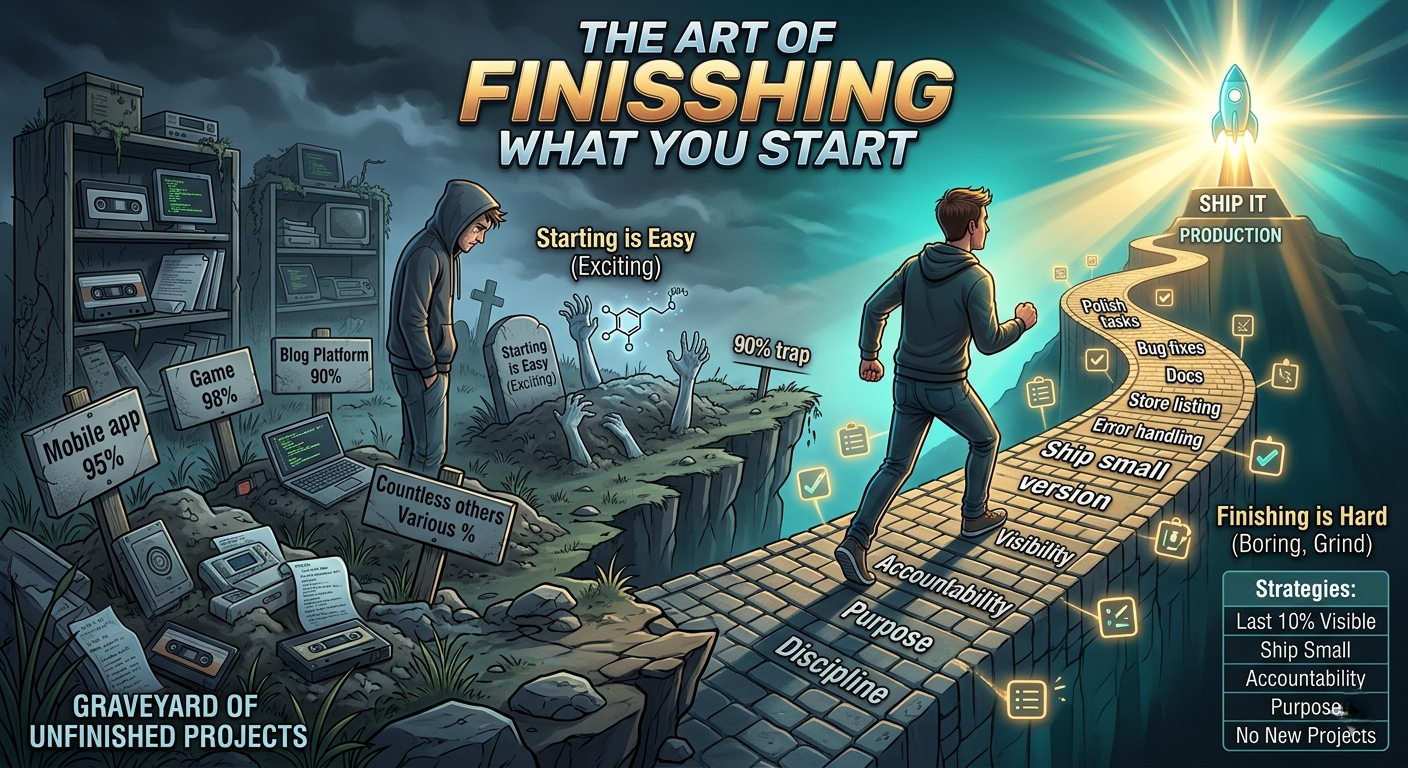
The Art of Finishing What You Start
I have a graveyard of unfinished projects. Side projects that were going to change everything. Brilliant ideas that fizzled. Code that never saw the light of production. Features that were 90% done and stayed that way forever.
I am not proud of this graveyard. But I have learned more from it than from any finished project.
Starting is easy. Starting is exciting. Starting is full of possibility and dopamine and the thrill of something new.
Finishing is hard. Finishing is boring. Finishing is where the last 10% takes 90% of the time and none of the glory.
Most developers I know are great starters. Few are great finishers. The ones who finish are the ones who ship. The ones who ship are the ones who matter.
Let me share what I have learned about the art of finishing what you start.
The Graveyard of Almost Done
I opened an old hard drive recently. I found projects I had forgotten about.
A mobile app. 95% complete. Never released.
The last 5% was boring. Store listings. Screenshots. Privacy policies. I moved on to something shinier.
A blog platform I built from scratch. 90% complete. Never deployed.
I got stuck on comment moderation. Then I lost interest. Then I started something else.
A game I worked on for months. 98% complete. Never shared.
The last 2% was polish. Balancing. Bug fixing. The fun part was over. The grind remained.
Each of these projects represents hours of my life. Effort. Learning. Growth. And zero impact. Because finishing did not happen.
The graveyard is full of almost. Almost done. Almost shipped. Almost mattered.
| Project | Completion | What Stopped Me |
|---|---|---|
| Mobile app | 95% | Boring last mile work |
| Blog platform | 90% | Got stuck, lost interest |
| Game | 98% | Polish and bug fixing |
| Countless others | Various | The thrill was gone |
Why Starting Is So Much Easier
Starting triggers reward centers in your brain.
New project. New possibilities. New identity.
You are not just a developer. You are an entrepreneur. A creator. Someone who builds things. The fantasy is intoxicating.
Starting has no resistance. No hard problems yet. No bugs that make no sense. No users complaining about things you never considered.
Starting is hope. Finishing is reality.
The brain knows this. So the brain resists finishing. It wants the dopamine of new. It avoids the boredom of complete.
I have learned to recognize this pattern. The moment I feel the urge to start something new, I check my unfinished projects first. There is almost always something there that is closer to done than whatever I want to start.
| Starting | Finishing |
|---|---|
| Exciting | Boring |
| Full of possibility | Full of reality |
| No resistance | All the resistance |
| Dopamine hit | Grind |
| Easy | Hard |
The 90% Trap
The most dangerous point in any project is 90% complete.
You have done the hard part. The core works. The demo is impressive. You feel like you are almost there.
But you are not almost there. You are at the edge of a cliff.
The last 10% is deceptive. It includes:
-
Error handling for cases you forgot
-
Edge cases that break everything
-
Documentation you promised to write
-
Testing that reveals hidden bugs
-
Deployment that never goes smoothly
-
Polish that takes forever
The 90% trap has killed more of my projects than anything else. I celebrate too early. I mentally check out. I start something new because this one is “basically done.”
It is not basically done. It is dangerously incomplete.
| What 90% Looks Like | What Is Actually Left |
|---|---|
| Core works | Edge cases are everywhere |
| Demo is impressive | Production is different |
| Feels almost done | 90% of the time remains |
| Mentally checked out | The hardest work is ahead |
The Developer Who Taught Me to Finish
I worked with a developer who was not the smartest person on the team. Not the fastest. Not the most creative.
But she finished everything.
Every task she started, she completed. Every project she touched, she shipped. Every feature she owned, she saw through to production.
I watched her work. She did nothing special. No secret technique. No productivity hack.
She just did not stop.
When the interesting part was over, she kept going. When the bugs were boring, she fixed them anyway. When the documentation was tedious, she wrote it.
She finished because she had decided that finishing was not optional. It was simply what you did.
I asked her about it once. She said: “Starting is a promise. Finishing is keeping it. I do not make promises I do not keep.”
| The Smart Developer | The Finishing Developer |
|---|---|
| Started many things | Finished most things |
| Had brilliant ideas | Had working software |
| Moved on when bored | Stayed until done |
| Talked about potential | Delivered results |
The Strategies That Help Me Finish
I am still learning to finish. But I have found strategies that help.
Make the last 10% visible.
I break down the remaining work into small tasks. Tiny tasks. Tasks that take minutes, not hours. Visible progress keeps me going when motivation fades.
Ship something, even if it is small.
Do not wait for everything to be perfect. Ship a minimum version. Get it in front of users. The feedback will motivate you to finish the rest.
Tell someone you will finish by a date.
Accountability works. Tell a friend. Tell a colleague. Post it publicly. The social pressure helps when internal motivation fails.
Remember why you started.
Go back to the original problem. Why did this matter? The excitement may have faded, but the problem probably still exists. Reconnecting to purpose helps push through boredom.
Do not start something new until this is done.
This is the hardest rule. No new projects. No shiny distractions. This project gets your attention until it ships. Discipline, not motivation.
| Strategy | Why It Works |
|---|---|
| Make the last 10% visible | Small tasks create progress |
| Ship something small | Feedback creates motivation |
| Tell someone a date | Accountability replaces willpower |
| Remember why you started | Purpose outlasts excitement |
| No new projects until done | Removes the escape route |
The Cost of Not Finishing
Every unfinished project has a cost. Not just the time you spent. Something deeper.
It trains your brain that finishing does not matter.
Each abandoned project reinforces the pattern. Your brain learns that starting is enough. Finishing becomes optional. The habit of abandonment grows stronger.
It steals your confidence.
Every unfinished project is a broken promise to yourself. Over time, you stop trusting yourself. You start new things with a secret certainty that you will not finish them.
It clutters your mind.
Open loops consume mental energy. The unfinished project sits in the back of your brain, whispering. You cannot fully focus on anything else because part of you knows you left something undone.
It wastes the learning.
You learned things on that project. But without a finished product, the learning is isolated. It does not become impact. It does not become value. It just becomes memory.
| Cost of Not Finishing | Why It Hurts |
|---|---|
| Trains your brain | Finishing becomes optional |
| Steals confidence | Broken promises to yourself |
| Clutters your mind | Open loops consume energy |
| Wastes learning | Knowledge without impact |
The Difference Between Perfect and Done
Perfectionism is the enemy of finishing.
Perfect code does not exist. Perfect design does not exist. Perfect products do not exist.
Waiting for perfect is waiting forever. It is a convenient excuse to stop before the hard part. It lets you off the hook.
Done is better than perfect. Shipped is better than imagined. Used is better than admired.
I have learned to ask myself: is this good enough? Not perfect. Good enough to ship. Good enough to learn from. Good enough to matter.
Most of the time, the answer is yes. The only thing stopping me is my own standards. Standards that serve no one. Standards that keep my projects in the graveyard.
| Perfectionist | Finisher |
|---|---|
| Waits for perfect | Ships good enough |
| Never finishes | Finishes often |
| Imagines ideal | Delivers real |
| Admires their own work | Gets feedback from users |
What I Learned from the Projects I Actually Finished
The projects I finished taught me more than the ones I started.
Finishing reveals what matters.
When you ship, you find out what users actually care about. Your assumptions are tested. Reality provides feedback. That feedback is more valuable than any planning.
Finishing builds momentum.
Each finished project makes the next one easier to finish. You prove to yourself that you can do it. The habit strengthens. Finishing becomes normal.
Finishing creates leverage.
A finished project is a asset. It can be shown. Shared. Sold. Improved. An unfinished project is nothing. It exists only in your head.
Finishing is rare.
Most people do not finish. Most developers do not ship. Finishing puts you in a different category. Not because you are smarter. Because you stayed when others left.
| Lesson from Finishing | Why It Matters |
|---|---|
| Reveals what matters | Reality tests your assumptions |
| Builds momentum | Each finish makes the next easier |
| Creates leverage | Finished work is an asset |
| Is rare | Finishing separates you from the crowd |
Closing Thoughts
I still have unfinished projects. The graveyard still grows. I am not perfect at finishing.
But I am better than I was.
I recognize the 90% trap now. I see it coming. I push through instead of starting something new. I ship good enough instead of waiting for perfect.
The art of finishing is not about talent. It is not about intelligence. It is not about having more hours in the day.
It is about deciding that finishing matters. That your promises to yourself are worth keeping. That shipping something imperfect is better than perfecting something that never sees the light.
Start fewer things. Finish more of them.
The graveyard does not need more headstones.
It needs shipping.
Leave a Reply