
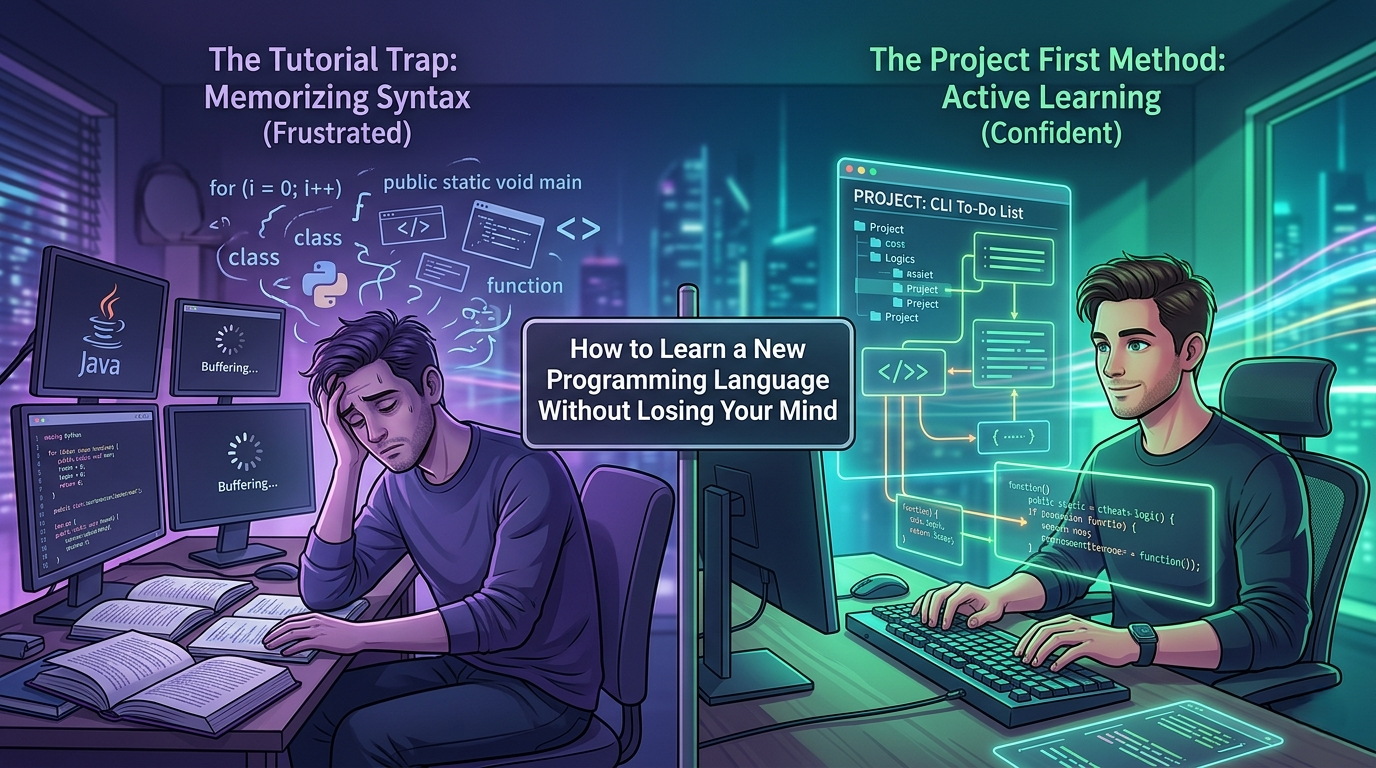
How to Learn a New Programming Language Without Losing Your Mind
I have learned more programming languages than I can count. Java, Python, JavaScript etc. Each time, I made the same mistakes. Each time, I felt the same frustration. Each time, I wanted to quit.
Learning a new language is hard. Not because languages are hard. Because we learn them wrong.
We open tutorials. We read documentation. We try to memorize syntax. We get bored. We give up. We feel stupid.
I have been through this cycle too many times. But I have also learned what works. What does not work. What makes the difference between fluency and frustration.
Let me share what I have learned about learning a new programming language without losing your mind.
The Mistake I Made Every Time
For years, I learned languages the same way.
I would find a tutorial. I would start at the beginning. Variables. Conditionals. Loops. Functions. Classes. I would read. I would type along. I would feel productive.
Then I would finish the tutorial. And I could not build anything.
The knowledge was there. In my head. Somewhere. But I could not access it. I could not combine the pieces. I could not solve a real problem.
I had learned syntax. I had not learned thinking.
The tutorial gave me fish. It did not teach me to fish. I knew what a loop was. I did not know when to use one. I knew what a class was. I did not know how to design one.
This is the trap. Learning the language is not the same as learning to think in the language.
| What I Learned | What I Did Not Learn |
|---|---|
| Syntax | When to use each construct |
| Individual features | How features combine |
| Toy examples | Real problem solving |
| The what | The why and when |
The Shift That Changed Everything
The shift came when I stopped trying to learn the language and started trying to build something with it.
I picked a small project. Something I had built before in another language. Something I already understood.
A command line tool. A simple web server. A data processor. Nothing fancy. Nothing that required deep knowledge of the language.
Then I built it. Without tutorials. Without step-by-step guides. Just me, the documentation, and a lot of searching.
This was slower at first. Much slower. I spent hours on things that would have taken minutes in a language I knew.
But I learned. I learned what I actually needed to know. I learned how to find what I did not know. I learned to think in the new language, not just translate from my old one.
| Tutorial-First | Project-First |
|---|---|
| Learn everything | Learn what you need |
| Passive reading | Active searching |
| No context | Real problem |
| Forgettable | Memorable |
| Boring | Frustrating but effective |
The Four-Phase Method I Use Now
I have developed a method. Four phases. Each with a specific goal. Each building on the last.
Phase 1: The Bare Minimum (Day 1)
Learn just enough to be dangerous. Variables. Basic types. Functions. Conditionals. Loops. That is it. Do not learn classes. Do not learn generics. Do not learn the advanced features you will not use yet. The goal is not mastery. The goal is to stop being completely lost.
Phase 2: Build Something Small (Days 2-5)
Pick a tiny project. Something you could build in an hour in your primary language. Build it in the new language. Use the documentation constantly. Search for everything. Copy-paste from examples. Do not worry about idiomatic code. Just make it work.
Phase 3: Build Something Real (Week 2)
Pick a project that actually matters. Something you will use. Something with multiple pieces. A tool for your own workflow. A small automation. Build it. This is where you learn the real language. Error handling. Edge cases. Libraries. Debugging.
Phase 4: Learn the Idioms (Week 3+)
Now learn how the language is meant to be written. Read other people’s code. Study the standard library. Learn the patterns. Refactor your project to be more idiomatic. This is where you go from knowing the language to thinking in it.
| Phase | Goal | Duration |
|---|---|---|
| Bare Minimum | Stop being lost | Day 1 |
| Build Something Small | Make it work | Days 2-5 |
| Build Something Real | Solve a real problem | Week 2 |
| Learn the Idioms | Think in the language | Week 3+ |
The Documentation Strategy
Documentation is essential. But reading it like a book is a mistake.
Do not read documentation. Hunt through it.
When you need something, search for it. Find the answer. Use it. Move on. The next time you need it, you will remember where to look. The time after that, you will remember the syntax.
Documentation is not a novel. It is a reference. Treat it that way.
I keep the documentation open constantly when I am learning. I search it dozens of times per hour. Over time, I search less. I remember more. The repetition of searching teaches me what matters.
| Reading Documentation | Hunting Documentation |
|---|---|
| Start to finish | Search as needed |
| Passive | Active |
| Forgettable | Memorable through repetition |
| Takes weeks | Takes minutes per search |
The Problem with Tutorials
Tutorials are not evil. They are just incomplete.
Tutorials show you one path. A clean path. A path with no obstacles. Real problems are not like that.
Tutorials give you the answer before you have asked the question. They rob you of the struggle. And the struggle is where learning happens.
I use tutorials now, but differently. I do not follow them. I use them as inspiration. I look at what they build, then I close them and try to build it myself. When I get stuck, I peek. Then I close again.
The struggle is the teacher. Tutorials that remove the struggle remove the learning.
| Following Tutorials | Using Tutorials for Inspiration |
|---|---|
| Passive copying | Active building |
| No struggle | Productive struggle |
| False confidence | Honest awareness of gaps |
| Forgettable | Memorable |
The First Project I Recommend
If you are learning a new language, build this.
A command line todo list.
It has everything. User input. Data storage. File I/O. Error handling. Basic CRUD operations. Small enough to finish. Complex enough to teach.
Do not use libraries. Not yet. Use only the standard library. Force yourself to learn what the language provides.
Add features incrementally. First, just print “hello world.” Then accept a command. Then add a task. Then list tasks. Then mark complete. Then delete. Then save to a file. Then load from a file.
Each step is small. Each step teaches something. Each step gives you a win.
| Step | What It Teaches |
|---|---|
| Hello world | Setup, compilation or interpretation |
| Accept a command | User input, basic parsing |
| Add a task | Variables, data structures |
| List tasks | Iteration, output |
| Mark complete | Mutation, indexing |
| Delete | Removal, shifting |
| Save to file | Serialization, file I/O |
| Load from file | Deserialization, error handling |
The Frustration Is Normal
Here is something I wish someone had told me.
Feeling stupid is part of learning. Not a sign that you are failing. A sign that you are learning.
When you cannot figure out something simple. When you search for the same thing three times in an hour. When your code looks nothing like the examples. This is not evidence that you are bad at learning languages. This is the normal experience of learning.
I have felt this every time. Every single language. Including languages similar to ones I already knew.
The frustration fades. Not because you stop struggling. Because you get used to struggling. Because you learn that struggle is the path, not an obstacle.
| Frustration Means | It Does Not Mean |
|---|---|
| You are learning | You are failing |
| You are stretching | You are not smart enough |
| You are building new connections | You will never get it |
| You are normal | You are different from everyone else |
The Languages I Failed to Learn
I have failed to learn some languages. Multiple times.
Elixir. I tried three times. Gave up three times.
The syntax was foreign. The functional paradigm was hard. The tooling was unfamiliar. I felt stupid. I quit.
Rust. I tried twice. Gave up twice.
The borrow checker broke my brain. I could not understand why my perfectly reasonable code was rejected. I got frustrated. I quit.
I am not proud of these failures. But I learned from them.
I learned that some languages require more struggle than others. That learning curves are not all the same. That quitting is sometimes the right choice, and coming back later is also valid.
I will try Elixir again. And Rust. When I am ready. When I have a project that needs them. When the frustration of not knowing them exceeds the frustration of learning them.
| Language | Attempts | What I Learned |
|---|---|---|
| Elixir | 3 | Some paradigms take longer |
| Rust | 2 | Some concepts need repeated exposure |
| Both | Ongoing | Quitting is not permanent |
What Success Looks Like
Success is not fluency. Success is not knowing everything.
Success is being able to build something without constant panic.
You still search. You still look things up. You still get stuck. But you believe you will figure it out. Because you have before.
That is fluency. Not knowing. Believing you can find out.
I am fluent in several languages. I still search for basic syntax sometimes. I still forget how to do things I have done a hundred times. I still ask colleagues for help.
But I do not panic. I know I will figure it out. Because I always have.
That is what learning a language actually looks like. Not perfection. Confidence in the process of figuring things out.
| Unrealistic Success | Realistic Success |
|---|---|
| Know everything | Know how to find anything |
| Never search | Search confidently |
| Never stuck | Get stuck, get unstuck |
| Perfect code | Working code |
| Fluency as destination | Fluency as direction |
Closing Thoughts
I am learning a new language right now. It is hard. I feel stupid sometimes. I search for the same thing over and over. My code is not elegant.
But I am not losing my mind.
Because I know the pattern now. I know the frustration is normal. I know the struggle is the learning. I know that in a few weeks, I will look back and laugh at what I found hard.
Learning a new language is not about intelligence. It is about persistence. It is about tolerating frustration. It is about building things, not just reading about them.
Pick a small project. Start today. Feel stupid. Keep going.
You will learn the language. Not because you are smart. Because you did not quit.
And that is the only skill that actually matters.
Leave a Reply