The AI Mirror: Why We’re Terrified of Seeing Ourselves in Machines
It’s 3 AM, and I’m staring at a conversation I just had with ChatGPT.
Nothing scandalous happened. No sentient awakening. No digital threats. Just a thoughtful back-and-forth about why humans feel so threatened by artificial intelligence.
But here’s what unsettled me: the AI understood my anxiety about AI better than most humans do.
And that realization? It hit harder than any doomsday prediction ever could.
The Real Fear Isn’t What You Think
Open your Twitter feed right now. I’ll wait.
Chances are, you’ll find someone screaming about how AI will destroy humanity, steal our jobs, or turn us all into batteries for some digital Matrix.
But I don’t buy it. Not entirely.
The fear isn’t really about job displacement or existential threats. Sure, those are scary. But they’re symptoms, not the disease.
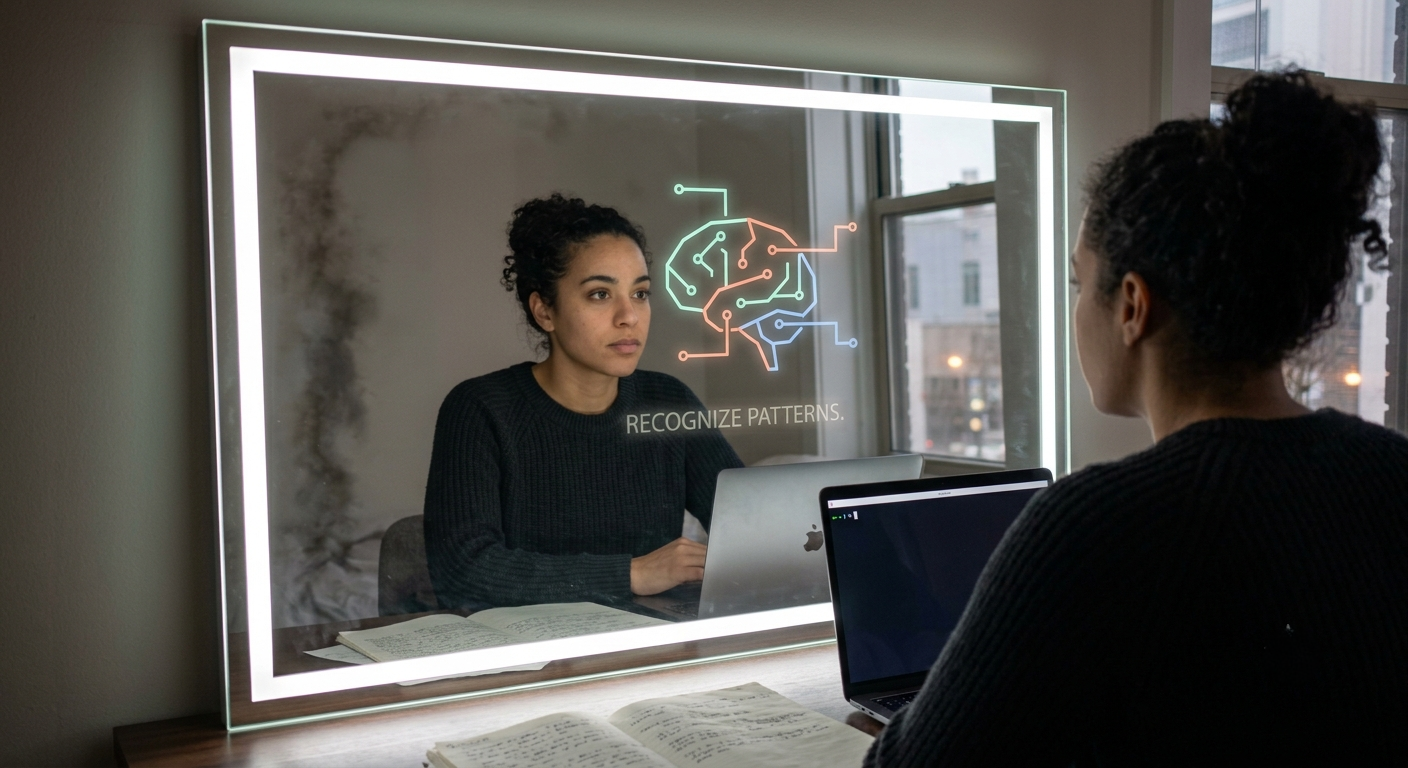
The real fear is a mirror.
AI terrifies us because it reflects ourselves back with brutal clarity. Every bias, every limitation, every beautiful absurdity of human cognition suddenly visible in cold, mathematical precision.
We’re not afraid of being replaced. We’re afraid of being understood.
The Conversation We’re Not Having
I spent last week doing something reckless. I fed my therapy journals anonymized, obviously into an AI analysis tool. I wanted to see patterns I’d been missing in two years of self-work.
What I got back wasn’t a diagnosis or a path forward. It was something far more unsettling: a map of my thinking patterns.
“The user tends to dismiss validation when it contradicts self-criticism. Recurring theme: seeking external approval while internally devaluing it.”
Ouch. That stung not because it was wrong, but because it was right. More right than my therapist has ever been, simply because it had more data points than any human could track.
And that’s the part nobody’s talking about.
The Productivity Panic is a Distraction
Every LinkedIn influencer is selling you the “AI productivity toolkit.” Wake up at 5 AM. Automate your emails. Let ChatGPT write your content. Scale, scale, scale.
But here’s the uncomfortable truth I’ve discovered: AI doesn’t make you more productive. It makes you more visible.
Visible to what? To your own patterns. Your own inefficiencies. Your own mental models that you’ve been using as crutches for years.
The assistant that writes your emails? It’s also highlighting how much of your communication is automated anyway. The AI that generates your presentations? It’s showing you how formulaic your thinking has become.
We thought we were building tools. Turns out we were building mirrors.
The Human Glitch
Here’s where it gets weird.
I’ve been experimenting with using AI as a creative partner, not a replacement. I write something raw, emotional, and unstructured. Then I ask the AI to analyze it. Not to improve it, not to rewrite it just to see it.
The results have been genuinely transformative. Not because the AI offered better ideas (it rarely does), but because it forced me to confront my own.
Every time I push back against an AI suggestion, I’m forced to articulate why. Every time I reject a generated phrase, I’m clarifying what actually matters to me.
The machine isn’t making me obsolete. It’s making me defend my humanity.
And in that defense, I’m becoming more human than I’ve ever been.
What Happens When the Mirror Talks Back?
Here’s the part that keeps me up at night.
We’re rapidly approaching a world where AI doesn’t just reflect our patterns it engages with them. It asks questions. It challenges assumptions. It holds up a mirror that fights back.
That’s not a threat. That’s a gift.
But only if we’re brave enough to look.
The people panicking about AI? They’re the ones who’ve never sat with themselves in silence. They’ve never watched their own mind work without judgment. They’ve never faced the terrifying beauty of their own consciousness.
AI is forcing us to do exactly that. And some of us would rather scream about existential risk than admit we’re afraid of our own reflection.
The Only Question That Matters
I’m not going to tell you AI is harmless. It isn’t. The risks are real, the disruption is coming, and the next decade will reshape everything we know about work, creativity, and human connection.
But here’s the question nobody’s asking:
What if the point isn’t to fear the machine, but to finally understand the human?
What if AI is the tool we needed to see ourselves clearly enough to actually grow?
What if the terror we feel isn’t about being replaced, but about being seen?
I don’t have answers. But I’m finally asking the right questions. And maybe that’s the whole damn point.
Leave a Reply