
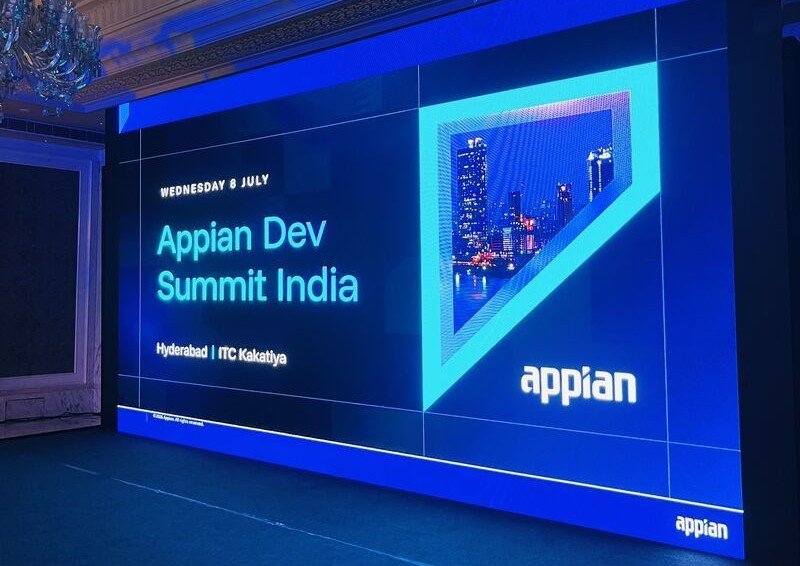
A few days ago, I had the opportunity to attend the Appian Dev Summit India, and it turned out to be much more than just a technology event. It was an experience filled with innovation, learning, networking, and a glimpse into the future of AI-powered application development.
As someone passionate about enterprise application development and digital transformation, the summit offered valuable insights into how Appian is evolving from a low-code platform into an intelligent ecosystem where AI, automation, and developer productivity seamlessly come together.
A Gathering of Innovators
One of the most impressive aspects of the summit was the community itself. The event brought together Appian’s product leaders, architects, developers, customers, and technology enthusiasts from various industries.
The conversations went beyond product demonstrations. Attendees openly discussed real-world implementation challenges, modernization strategies, AI adoption in enterprises, and the future role of developers in an increasingly AI-assisted world.
Connecting with Appian’s core teams and experienced practitioners provided a unique opportunity to understand not only what Appian is building but also why these innovations matter for modern enterprises.
The AI-First Direction of Appian
A clear theme throughout the summit was Appian’s commitment to becoming an AI-first development platform. Rather than treating AI as an add-on feature, Appian is deeply embedding intelligence across the entire software development lifecycle.
What stood out was the practical approach. The focus wasn’t on AI for the sake of AI. Instead, every innovation aimed to solve real developer and business challenges such as reducing manual effort, simplifying application maintenance, accelerating modernization, and improving operational visibility.
Key Learnings and Product Innovations
1. Appian MCP (Model Context Protocol): Connecting AI Agents to Enterprise Workflows
One of the most exciting announcements was the introduction of Appian MCP Servers, including:
- Dev MCP Server
- Doc MCP Server
This represents a major step toward enabling AI agents to interact intelligently with enterprise systems and development environments.
Why This Matters
Traditionally, AI assistants have been limited by the context they can access. MCP changes this by providing a standardized way for AI agents to understand applications, documentation, workflows, and enterprise data.
This opens possibilities such as:
- AI-driven development assistance
- Intelligent process discovery
- Context-aware recommendations
- Automated workflow orchestration
- Faster collaboration between teams and AI systems
The concept aligns perfectly with the industry’s movement toward autonomous and agentic AI systems.
My biggest takeaway was that Appian is positioning itself as a platform where AI agents can become active participants in application development rather than simple chat interfaces.
2. Appian Dev Agent: A New Era of Developer Productivity
Another standout announcement was the Appian Dev Agent.
Most developers have experienced situations where updating one application object triggers a series of additional updates throughout the system. Traditionally, identifying all dependent components requires manual effort and deep system knowledge.
The Dev Agent aims to solve this challenge.
What Makes It Powerful
Instead of simply modifying a requested object, the AI can:
- Understand application context
- Identify dependent objects
- Recommend necessary updates
- Automatically perform related modifications
- Reduce repetitive development tasks
Real-World Impact
For enterprise applications consisting of hundreds or even thousands of objects, this capability can significantly reduce:
- Development effort
- Human error
- Technical debt
- Maintenance costs
As applications grow more complex, intelligent assistants like Dev Agent will become essential productivity tools rather than optional conveniences.
3. Reverse Engineering with Appian Composer
This announcement resonated strongly with me because many organizations still operate legacy applications that lack proper documentation.
The enhanced Appian Composer now supports reverse engineering capabilities.
What It Can Do
AI can analyze existing applications and:
- Explain business processes
- Understand application architecture
- Map relationships between components
- Generate documentation
- Identify improvement opportunities
Why Organizations Need This
Many enterprises face challenges because:
- Original developers have moved on
- Documentation is outdated
- Business logic is difficult to understand
- Application complexity continues to grow
The ability to quickly understand legacy systems can dramatically accelerate modernization initiatives and reduce risk during application transformations.
4. CDT to Record Type Migration
For experienced Appian developers, this announcement was long overdue.
The transition from legacy Custom Data Types (CDTs) to Record Types has historically required considerable effort, especially in large-scale applications.
The New Migration Support Enables
- Faster modernization
- Reduced migration complexity
- Better maintainability
- Improved adoption of modern Appian architecture
For organizations running mature Appian implementations, this feature can significantly reduce migration timelines and costs.
Modernization projects that once seemed risky now feel much more achievable.
5. Enhanced Dynatrace Integration: Smarter Observability
Observability has become a critical requirement for enterprise applications.
The enhanced integration between Appian and Dynatrace introduces:
- Deep transaction tracing
- Trace ID support
- Faster root cause analysis
- Real-time operational insights
- Improved performance monitoring
Why This Is Important
Development does not end after deployment.
Maintaining application performance requires visibility into:
- Application behavior
- Performance bottlenecks
- Production issues
- User experience
With richer observability, teams can diagnose problems faster and improve overall platform reliability.
This is particularly valuable for mission-critical applications where even small performance issues can have significant business impact.
6. Plugin Composer: Greater Development Freedom
While Appian’s low-code environment covers many business requirements, there are situations where organizations need custom functionality.
The introduction of Plugin Composer empowers developers to:
- Build custom plugins faster
- Reduce external dependencies
- Extend platform capabilities
- Accelerate solution delivery
This innovation strikes a balance between low-code simplicity and professional-code flexibility.
Developers no longer need to wait for external development cycles when specialized functionality is required.
7. AI-Powered Development and the Rise of “Vibe Coding”
Throughout the summit, one phrase repeatedly surfaced: AI-powered development.
The combination of:
- Appian Composer
- Dev Composer
- Dev Agent
- MCP Servers
signals a major shift in how applications will be built in the future.
Rather than spending time on repetitive technical implementation, developers can increasingly focus on:
- Business outcomes
- Process optimization
- User experience
- Solution architecture
AI becomes a development partner that accelerates delivery while allowing engineers to concentrate on higher-value work.
This evolution is transforming low-code development into intelligent development.
8. Appian Documentation Center
Although not as flashy as AI announcements, the new Documentation Center may prove equally valuable.
Having centralized access to:
- Product documentation
- Learning resources
- Best practices
- Development guidance
helps reduce friction for developers at every experience level.
Good documentation remains one of the most important enablers of successful technology adoption, and Appian’s investment in this area reflects its commitment to the developer community.
Beyond Technology: The Human Element
While the product announcements were impressive, the most valuable part of the summit was interacting with the people behind the platform.
Listening to leaders such as James Lee, Kaushik Roy, Gregg Aldana, Evelyn Han, and the broader Appian team provided insights into the strategic vision driving these innovations.
What stood out was their focus on solving practical enterprise challenges rather than pursuing technology trends for their own sake.
The discussions demonstrated a clear understanding that organizations need platforms capable of balancing:
- Speed of development
- Governance
- Scalability
- AI innovation
- Long-term maintainability
That balance is increasingly difficult to achieve, and Appian appears committed to addressing it.
My Biggest Takeaway
If I had to summarize the summit in one sentence, it would be:
Appian is no longer just evolving low-code development; it is redefining how humans and AI collaborate to build enterprise software.
The combination of AI agents, intelligent development assistance, reverse engineering, modernization tools, observability improvements, and extensibility features demonstrates a platform that is preparing organizations for the next generation of application development.
As a developer and technology consultant, I left the event inspired by the possibilities ahead. The innovations showcased at the summit have the potential to significantly improve how enterprise applications are designed, built, maintained, and modernized.
I am excited to explore these capabilities further and evaluate how they can be leveraged to deliver smarter, faster, and more scalable solutions for real-world business challenges.
Final Thoughts
Attending the Appian Dev Summit India was an enriching experience that reinforced an important reality: the future of software development will not be about replacing developers with AI. Instead, it will be about empowering developers with intelligent tools that amplify their capabilities.
The summit provided a clear vision of that future, and I am grateful to have been part of the conversation.
Here’s to the next generation of AI-powered, low-code innovation and the exciting journey ahead.


Leave a Reply