
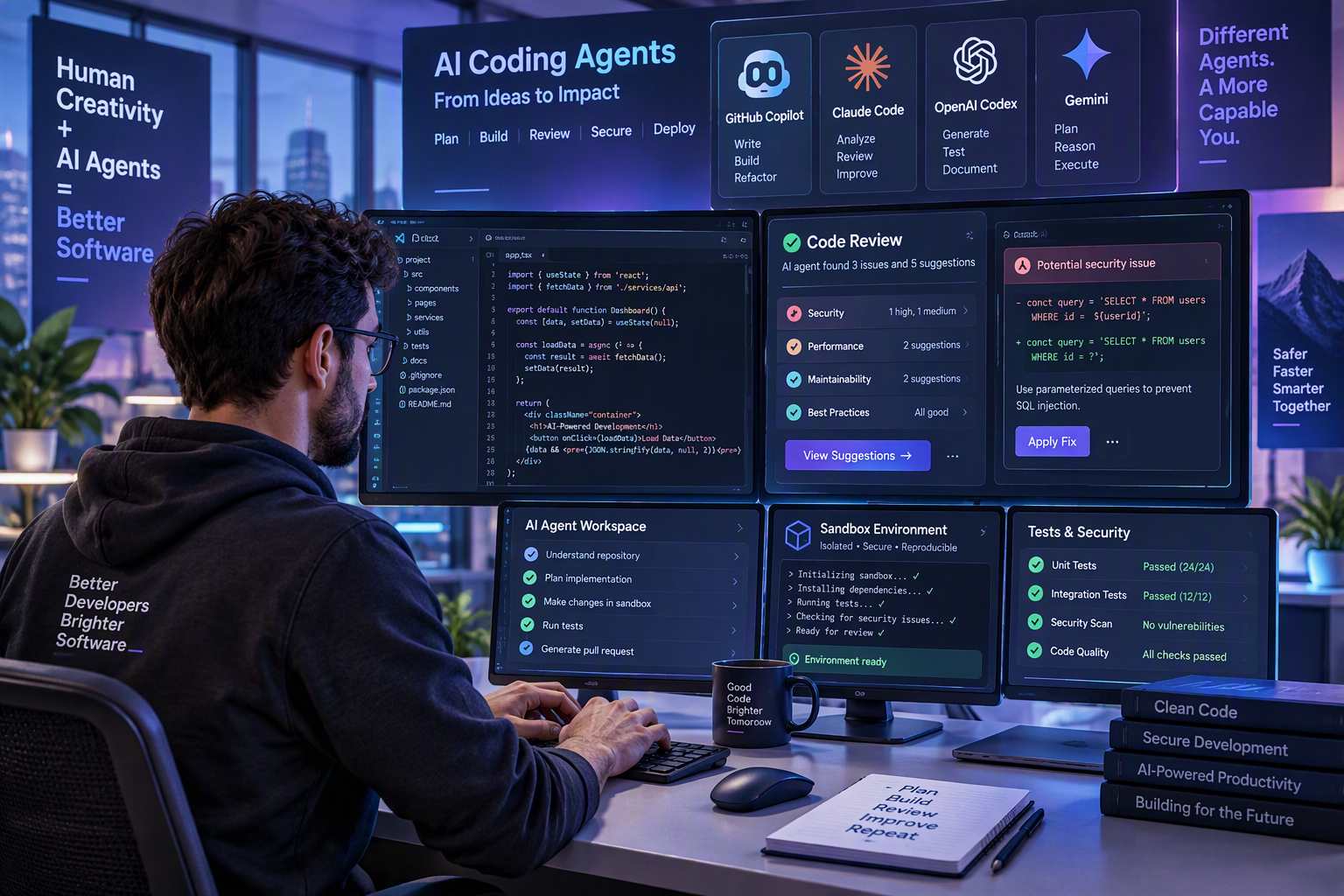
Artificial intelligence has transformed software development far beyond code autocomplete. Today’s AI coding agents can analyze repositories, execute multi-step development tasks, generate pull requests, review code, and help teams maintain large applications. As these tools become more capable, a new question has emerged: can developers trust them?
Recent updates from the major coding assistants — GitHub Copilot, Claude Code, OpenAI Codex and Gemini — indicate that the industry focus is shifting. Instead of competing solely on coding speed, vendors are investing heavily in review workflows, sandboxing, governance controls, and security mechanisms.
For developers, this change is significant. The next generation of AI coding agents is not just about writing code faster. It is about producing trustworthy software while reducing risk.
AI Coding Agents: From Assistants to Autonomous Contributors
AI coding tools started as intelligent autocomplete systems. They suggested functions, completed code blocks, and answered programming questions.
Modern coding agents operate differently.
They can:
- Read entire codebases
- Understand project context
- Modify files across repositories
- Generate tests
- Detect bugs
- Perform code reviews
- Create pull requests
- Execute workflows using connected development tools
This evolution allows developers to delegate larger tasks and focus on architecture, business logic, and decision-making.
Coding agents are increasingly being designed to work across entire software projects rather than individual files. Vendors are expanding context windows, repository awareness, and task automation capabilities.
AI Coding Agents Are Taking on Bigger Responsibilities
As organizations adopt AI-assisted development, expectations are growing rapidly.
Instead of asking an AI to write a single function, developers now ask it to:
- Refactor legacy applications
- Generate documentation
- Identify technical debt
- Create testing strategies
- Implement feature requests
- Review pull requests
- Troubleshoot deployment issues
Coding platforms are actively expanding support for these larger workflows, introducing repository-wide reviews, isolated work environments, larger context windows, and automated validation processes.
The result is greater productivity. However, larger autonomy introduces greater risk.
Why Speed Is No Longer the Main Differentiator
For the past few years, AI tool comparisons largely focused on speed and code generation quality.
Questions included:
- Which model generates better code?
- Which assistant is faster?
- Which tool supports more languages?
These questions still matter, but enterprises are increasingly asking different questions:
- Can the agent be trusted?
- What permissions does it have?
- Can its actions be audited?
- How are mistakes detected?
- How is sensitive data protected?
These concerns are now driving product roadmaps across the AI coding ecosystem.
The reason is simple.
Writing code is relatively easy for AI.
Writing secure, reliable, compliant code consistently is much harder.
The Rise of Code Review Automation
One of the biggest developments in AI-assisted software engineering is automated code review.
Instead of reviewing only generated code, modern systems can inspect human-written and AI-generated contributions alike.
Code review capabilities are moving from experimental features into broader production usage, helping teams identify bugs, security issues, performance concerns, and coding standard violations before deployment.
Benefits of AI-Powered Code Review
AI-assisted code review can:
- Detect common vulnerabilities
- Identify edge cases
- Flag inconsistent implementation patterns
- Recommend best practices
- Improve documentation quality
- Accelerate pull request processing
For distributed development teams, these capabilities help reduce review bottlenecks while maintaining coding standards.
However, experienced engineers should treat AI review as a supplement rather than a replacement for peer review.
Human judgment remains essential for evaluating business requirements, architectural decisions, and long-term maintainability.
Sandboxing: The New Security Standard
One recurring theme across recent AI coding releases is sandboxing.
A sandbox is an isolated environment where an AI agent can perform actions without affecting production systems.
This approach provides several advantages:
Reduced Risk
If the agent generates faulty code or executes an incorrect command, the damage remains contained.
Better Testing
Teams can inspect changes before merging them into production environments.
Improved Governance
Organizations gain greater visibility into agent actions and permissions.
Easier Auditing
Security teams can review exactly what the AI agent accessed and modified.
As coding agents gain the ability to execute tasks independently, sandboxing is becoming a critical requirement rather than an optional feature.
Trust, Verification, and Human Oversight
The biggest challenge facing AI coding agents is trust.
Developers frequently encounter situations where generated code:
- Compiles successfully
- Appears correct
- Passes basic tests
Yet still contains hidden flaws.
This problem has led vendors to introduce additional verification layers, including:
- Automated validation
- Permission controls
- Workflow approvals
- Review checkpoints
- Audit logging
Industry discussion around agentic AI places growing emphasis on governance and verification before autonomous actions are allowed in production environments.
A useful principle for development teams is:
Trust the output only after verification, not before.
AI can accelerate implementation, but engineering accountability still belongs to humans.
Best Practices for Developers Using AI Coding Agents
As AI coding tools become standard components of developer workflows, teams should adopt clear operating practices.
1. Keep Humans in the Approval Loop
Allow agents to propose changes, but require human approval before merges.
This approach balances productivity and risk.
2. Use Principle of Least Privilege
Grant coding agents only the permissions required for their tasks.
Avoid unrestricted repository or infrastructure access whenever possible.
3. Require Automated Testing
Every AI-generated change should pass:
- Unit tests
- Integration tests
- Security scans
- Quality gates
before deployment.
4. Monitor Agent Activity
Maintain logs covering:
- Files modified
- Commands executed
- External systems accessed
- Generated pull requests
These records improve accountability and troubleshooting.
5. Establish AI Development Guidelines
Organizations should document:
- Approved AI tools
- Security requirements
- Review workflows
- Data handling policies
- Compliance expectations
Clear standards reduce operational risk while supporting consistent adoption.
What Developers Should Expect Next
The next wave of innovation will likely focus on making coding agents more reliable rather than simply more powerful.
Key areas to watch include:
Autonomous Development Workflows
Agents will handle increasingly complex feature implementation and maintenance tasks.
Stronger Governance Controls
Enterprise buyers are demanding permission systems, audit capabilities, and compliance frameworks.
Multi-Agent Collaboration
Future platforms may use specialized agents for development, testing, documentation, and security review.
Security-First Architectures
Vendors continue investing in safeguards such as sandboxing, validation pipelines, and controlled access models.
These improvements will help organizations scale AI-assisted development without compromising quality or security.
Conclusion
AI coding agents are rapidly becoming valuable members of modern software teams. They can generate code, review changes, understand repositories, and automate repetitive engineering work.
But as their responsibilities grow, speed alone is no longer enough.
The most successful AI coding platforms in 2026 are focusing on trust, verification, governance, and security. The clear shift is toward review automation, sandboxed execution, permission controls, and accountable workflows.
For developers, the opportunity is clear: use AI to accelerate delivery while maintaining rigorous engineering standards. The future of AI-assisted development belongs not to the fastest coding agent, but to the most trustworthy one.



Leave a Reply